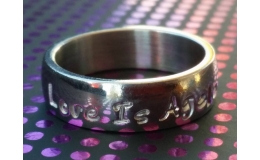
A 3mm band is slim and delicate, best for a single short name, initials or a tiny symbol. A 6mm band is the all-round middle choice with room for a name plus a date or a short phrase, and an 8mm band is wide and bold, giving words the most space and the strongest presence on the hand. Pick the width by how much you want to say first, then by how you like a ring to look and feel.
What does ring width actually measure?
Width is the distance across the top of the band, from the edge nearest your knuckle to the edge nearest your palm. It is not the same as thickness, which is how deep the metal is. When you see “3mm” or “8mm” on a listing, it tells you how tall the stamping surface is, and that single number shapes almost everything about a name ring: letter height, how many lines of meaning you can fit, and whether the piece reads as dainty or chunky.
At Mira’s Name Rings we offer six widths (3mm, 4mm, 5mm, 6mm, 8mm and 10mm), but the three people ask us about most are 3mm, 6mm and 8mm, so that is where this guide focuses.
How do 3mm, 6mm and 8mm compare at a glance?
| Width | Overall look | Good for | Feel on the finger |
|---|---|---|---|
| 3mm | Thin, minimal, stack-friendly | One short name, initials, a single symbol | Barely noticeable; easy for all-day wear |
| 6mm | Balanced, classic band | A name plus a date, two names, a short saying | Comfortable for most hands; noticeable but not heavy |
| 8mm | Wide, bold, statement | Longer phrases, several names, symbols mixed with words | Covers more of the finger; some people size up slightly |
How many letters fit on each width?
This is the question we hear most, and the honest answer is: it depends. Ring size changes the length of the band, the letters you choose change how much room each one takes (a “W” is wider than an “I”), and spaces, hearts or other symbols eat into the total. So treat the following as a loose rule of thumb rather than a promise.
Think about the math for a moment. A ring’s inside circumference grows with its size, so a size 10 simply has more surface to work with than a size 5. Wider bands do not usually add more letters around the ring; instead they allow bigger letters or, on some designs, more visual breathing room. That means the real trade-off is often between fitting more characters at a small letter height on a narrow band, versus fewer characters that read boldly on a wide one.
Some rough guidance from the bench:
- 3mm: Keep it short. One name, a set of initials, or a word like “breathe” usually looks cleanest. Narrow bands simply look tidier with less on them and with smaller lettering, because crowding a slim surface makes words hard to read.
- 6mm: Comfortable territory for a first name with a year, two names joined by a heart, or a brief phrase. Many messages that feel cramped on a slim ring relax nicely here.
- 8mm: The most forgiving width for longer sayings, a list of children’s names, or words mixed with symbols such as an anchor or infinity sign.
If your message is long, remember that you can also split it: part on the outside and part as a secret message inside the band, or front and back so a phrase lines up a certain way. When you are unsure, send us your wording through the contact page and we will tell you how it is likely to look before we stamp anything.
Which width looks best?
Style is personal, but a few patterns hold up well.
When 3mm shines
Thin bands feel modern and understated. They pair easily with an engagement ring or other jewelry, and they are made for stacking. Our 3mm thin shiny silver name ring is the simplest version, and the stackable sets of two, three or four let you give each ring its own name. A family stack, with one child per band, is a lovely way around the limited space on a single narrow ring.
Why 6mm is the safe middle
Six millimeters looks like a “real” ring on almost any hand without dominating it. It works for men and women alike, and it is wide enough that a name stays legible from across a table. Edged designs like our silver 6mm with raised borders frame the stamping with a raised border, which gives the words a finished, tidy look.
Who should go with 8mm
Wide bands suit larger hands, thumb rings and anyone who wants their message front and center. An 8mm shiny silver name ring gives bigger, bolder letters, and the extra surface makes it easier to combine a phrase with a symbol. If you want to go even further, a 10mm flat band is the widest we make.
Does band width change how a ring feels?
Yes, more than many people expect. A wider band covers more of the space between knuckles, so it can feel snugger than a narrow ring of the same size. As general jewelry advice, many people go up about a half size when moving to a wide band, especially if their knuckles are larger than the base of the finger. That is a common rule across the jewelry world, not a fixed rule for every hand, so if you are between sizes, check your size in the evening, when hands are usually at their fullest.
Every band we sell has a comfort-fit interior, curved slightly on the inside so wide edges never press into the skin. That helps a lot with wider styles. Everything is 316L surgical stainless steel, hypoallergenic with very low nickel release, so the extra metal touching your skin on an 8mm band is not a concern for most people with sensitive skin. If a doctor has ever told you that you react to certain metals, ask them before buying any ring.
How should you match width to the occasion?
- Everyday reminder ring: 3mm to 5mm, so it disappears into daily life until you glance down.
- Couples or promise rings: often a 6mm for one partner and a 3mm or 4mm for the other, stamped with matching words.
- Mother’s or family ring: a stack of 3mm bands, or a single 8mm with every name around it.
- Work ring for busy hands: a 6mm is sturdy and not too wide to grip tools comfortably. Stainless steel holds up well for gardeners, mechanics and nurses.
- Statement or thumb ring: 8mm or 10mm, where the width has room to look intentional.
What about 4mm, 5mm and 10mm?
The in-between sizes are useful when you love the delicacy of a thin ring but need slightly larger letters. A 4mm band is a small step up from 3mm, and 5mm lands right between dainty and classic. The 10mm flat band is the widest choice and suits bold sayings or anyone who wants the ring to be the centerpiece of an outfit. You can browse all of these together in our silver band collection.
For more answers about sizing, letter colors and care, see our name ring FAQ.
Ready to choose your width?
Write out your words first, count them, and then pick the width that lets them breathe. If the message is short and sweet, go slim; if it carries a lot of meaning, give it room. Every ring is hand-stamped to order and ships the same day, so you can browse every width in the shop and start with the words that matter to you.
Frequently asked questions
Is a 6mm ring too wide for a woman?
Not usually. A 6mm band reads as a classic width on most hands, though people with very slender fingers sometimes prefer 4mm or 5mm for a lighter look.
Should I size up for an 8mm ring?
Many jewelers suggest going about a half size up for wide bands because they cover more of the finger. Measure when your hands are warm and consider your knuckle size before deciding.
Can a long phrase fit on a 3mm ring?
Long phrases tend to look crowded on a thin band. Splitting the words between the outside and inside, or choosing a wider ring, usually gives a cleaner result.
What is the difference between ring width and thickness?
Width is how tall the band is across the top of the finger, while thickness is how deep the metal is from outside to inside. Width is the number that decides how much room you have for stamping.