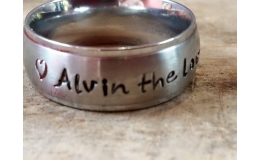
You can find your ring size at home in about five minutes. Either wrap a strip of paper or string around the base of your finger and measure its length in millimeters, or measure the inside diameter of a ring that already fits. Then match that number to the US ring size chart below, which covers sizes 3 through 16.
What do you need to measure your ring size?
- A strip of paper about a quarter-inch wide, or a piece of non-stretchy string or floss
- A pen or fine marker
- A ruler marked in millimeters
- Optional: a ring that already fits the finger you’re measuring
Paper works a little better than string because it doesn’t stretch or dig into your skin, which can make the reading too small.
How do you measure your finger with a paper strip or string?
- Wrap the strip snugly around the base of the finger where the ring will sit. It should feel like a ring would: secure, not tight.
- Mark the spot where the end overlaps.
- Check that the loop can slide over your knuckle. If it can’t, loosen it slightly and re-mark.
- Lay the strip flat and measure from the end to your mark in millimeters. That’s your finger’s circumference.
- Find the closest circumference in the chart. If you fall between two sizes, choose the larger one.
Repeat the measurement two or three times, ideally at different times of day. Fingers can change size noticeably between a cool morning and a warm evening.
How do you measure a ring you already own?
This is often the most accurate method, especially for a surprise gift. Set a ring that fits the right finger on a flat surface and measure straight across the inside, from one inner edge to the other, in millimeters. Don’t include the metal itself. That number is the inside diameter. Match it to the middle column of the chart.
A couple of cautions: measure a ring from the same finger and hand, since dominant hands often run slightly larger, and use a ring of similar width if you can, because band width affects fit (more on that below).
US ring size chart: sizes 3 to 16
This chart uses the standard US sizing scale, where each full size adds about 0.8mm to the inside diameter (roughly 2.6mm of circumference). Half sizes fall about halfway between the rows.
| US size | Inside diameter (mm) | Inside circumference (mm) |
|---|---|---|
| 3 | 14.1 | 44.2 |
| 4 | 14.9 | 46.8 |
| 5 | 15.7 | 49.3 |
| 6 | 16.5 | 51.9 |
| 7 | 17.3 | 54.4 |
| 8 | 18.1 | 57.0 |
| 9 | 18.9 | 59.5 |
| 10 | 19.8 | 62.1 |
| 11 | 20.6 | 64.6 |
| 12 | 21.4 | 67.2 |
| 13 | 22.2 | 69.7 |
| 14 | 23.0 | 72.3 |
| 15 | 23.8 | 74.8 |
| 16 | 24.6 | 77.4 |
Printable paper sizers are another option, but check that your printer is set to 100 percent scale, or the measurements will be off. Hold a ruler against the printed scale to confirm before you rely on it.
Tips for getting an accurate measurement
- Measure at room temperature. Cold shrinks fingers; heat and exercise make them swell.
- Measure late in the day. Fingers tend to be slightly larger in the evening.
- Mind your knuckle. If your knuckle is much wider than the base of your finger, size for the knuckle so the ring slides on, and expect a slightly looser fit below it.
- Measure the exact finger. Ring fingers, thumbs and pinkies on each hand all differ.
- Avoid measuring after salty meals or long flights, when many people retain a little water.
Does band width change your ring size?
Yes, a little. A wider band covers more of your finger, so it feels snugger than a thin one in the same size. Many jewelers suggest considering a quarter to half size up for very wide bands, especially if you’re between sizes. Comfort-fit bands, which have a gently rounded inside, slide over the knuckle more easily and soften that difference, and every ring we make is comfort-fit.
Here’s how width typically plays out:
| Band width | Fit compared with your measured size |
|---|---|
| 3mm–4mm | True to your measurement |
| 5mm–6mm | Close to true; slightly snugger |
| 8mm–10mm | Noticeably snugger; consider going up if between sizes |
For example, if you measure right between a 9 and a 10 and you’ve fallen for the 8mm silver edged name ring, the larger size is usually the more comfortable choice. The same goes for stacks: two or three slim rings worn together, like the two-ring 3mm gold stackable set, behave a bit like one wider band.
How do you figure out ring size for a surprise gift?
Measuring someone without asking takes a bit of detective work. A few approaches that work well:
- Borrow a ring they wear on the same finger for an hour, measure the inside diameter, and put it back.
- Place one of their rings on a piece of paper and trace carefully around the inside edge, then measure across the circle.
- Try their ring on your own fingers and note where it stops, then measure that spot on yourself.
- Ask a close friend or family member, who may already know or can find out.
If you have to guess, average women’s sizes tend to cluster around 6 to 7 and men’s around 9 to 10, but those are only rough starting points, and a real measurement always beats them.
What about rings for kids, thumbs and pinkies?
The smaller end of the chart, sizes 3 to 5, often fits children, teens and pinky fingers, while sizes 12 and up are common for thumbs and larger hands. Children’s fingers grow quickly, so many parents choose a size slightly larger than the current measurement.
Why measuring carefully matters for steel rings
Stainless steel is far harder than gold or silver. That toughness is a big reason steel rings stay scratch-resistant and keep their shape, but it also means they generally can’t be stretched or resized the way softer precious-metal rings sometimes can. Taking a few minutes to measure well is the best way to get a ring you’ll wear every day.
We make name rings in US sizes 3 through 16, so nearly every finger, from a child’s pinky to a large thumb, is covered. If you’re still unsure, our ring sizing and ordering FAQ has more help, or you can reach out with your measurements before you order.
Ready to make yours?
Got your number? Choose a width, pick a color and tell us what to stamp. Find your ring in the full shop, or start with our classic silver name bands.
Frequently asked questions
What is the inside diameter of a size 7 ring?
A US size 7 ring has an inside diameter of about 17.3mm, which works out to an inside circumference of roughly 54.4mm.
Should I size up for a wide band?
Wide bands such as 8mm and 10mm feel tighter than thin rings of the same size. If you measure between two sizes, choosing the larger one is usually more comfortable.
Can a stainless steel ring be resized?
Generally no. Stainless steel is too hard to stretch or resize the way gold or silver often can, so it's worth measuring carefully before ordering.
Is string accurate for measuring ring size?
String can work, but it may stretch or press into the skin and give a reading that's too small. A narrow paper strip is usually more reliable.